
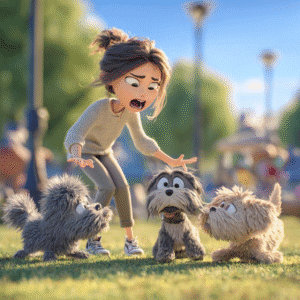
The chaos-proof, connection-first guide to raising a confident pup.
If you’ve ever heard “you need to socialise your puppy,” chances are no one actually explained what that means. Big mistake. Because most people assume “socialisation” = “let my puppy meet every dog, every person, every toddler and every seagull on the pier in one afternoon.”
Then they wonder why their puppy turns into a nervous wreck or an overexcited nuisance gremlin.
Let’s fix that.
Before we begin, if you’re still choosing your future shadow, take the Which Dog Breed is Best for Me? Quiz. Some breeds are born ready for the world. Some need a softly-softly approach and several snacks.
Pickles’ Aside: If someone marched me through Tesco to ‘socialise me’, I’d scream.
What Socialisation ACTUALLY Is
Socialisation isn’t:
- letting your puppy say hello to every dog on earth
- passing your puppy around like a hot potato
- terrifying them until they “learn to cope”
- exposing them to chaos “to toughen them up”
- flooding them with experiences
Socialisation is:
Helping your puppy learn that the world is safe, predictable and full of things they can handle calmly.
That’s it.
That’s the whole secret.
Pickles’ Aside: Calm puppy = fewer crimes.
The 3 Biggest Mistakes Puppy Parents Make
1. Thinking More Exposure = Better Socialisation
No.
Absolutely not.
Your puppy is not a sponge; they’re a tiny emotional creature.
More is not better.
Better is better.
Owner insight:
“I thought taking my puppy everywhere would help. What it actually did was create a dog who couldn’t settle anywhere.”
What to do instead:
- short, gentle exposures
- distance first
- sniffing, watching, learning quietly
Think sightseeing, not crowd surfing.
2. Forcing Interactions With Dogs or People
Puppies don’t want to meet everyone.
Some do.
Some don’t.
Both are normal.
Pushing them into interactions teaches fear, not confidence.
Signs they don’t want to approach:
- slowing down
- hiding behind you
- lip licking
- head turning
- tail tucked
- looking up at you for rescue
If you see these?
Move away.
You are their safe place, not their PR manager.
Pickles’ Aside: If I hide behind you, please take the hint and leave the situation immediately.
3. Overdoing It During the Fear Periods
Puppies go through two fear periods:
- around 8 to 12 weeks
- again, around 6 to 14 months
During these windows, a leaf blowing down the street can be “too much”.
The mistake is assuming the puppy “shouldn’t be scared”.
They should.
It’s developmental.
Your job is to:
- reduce intensity
- create safety
- help them observe, not endure
Owner insight:
“During my pup’s fear phase, even the garden hose was terrifying. We gave him space, and the fear vanished in a week.”
So What Should Socialisation Look Like?
Here’s the CrazyDogs Socialisation Blueprint — simple, calm, kind and incredibly effective.
1. Start With Watching, Not Doing
Sit somewhere quiet and let your puppy observe:
- Dogs at a distance
- Kids playing far away
- Bikes
- Electric Scooters
- Prams/Pushchairs
- Traffic
- Birds/Ducks
- The world being weird
Your puppy doesn’t need to be in the middle of it.
They just need to learn it’s normal.
Pickles’ Aside: Watching chaos is far safer than joining it.
2. Pair Everything New With Something Nice
See a:
- bin lorry
- jogger
- scooter
- loud voice
- mobility scooter
- bearded man
- kid with a football
Instantly follow with:
- a treat
- calm praise
- soft reassurance
This teaches: “New thing = good things happen.”
Owner insight:
“We treated the world like a buffet of opportunities to feed our puppy. Confidence skyrocketed.”
3. Control the Distance First
Always start far enough away that your puppy can:
- look
- sniff
- process
- stay calm
Then decrease the distance slowly over days or weeks, not minutes.
If your puppy stiffens, stares, hides or freezes?
You’re too close.
4. Choose Doggy Friends Carefully
Your puppy does not need:
- Every dog at the park
- rude dogs
- boisterous dogs
- “It’s okay, he’s friendly!” dogs
- dogs with zero recall
- dogs who think rugby tackling is a greeting
What they DO need:
- gentle adults
- calm puppies
- polite sniff-and-walks
- predictable play
- short play bursts
Pickles’ Aside: I do not want Kevin the Labrador throwing himself at me. Nobody wants Kevin.
5. Socialise to Handling, Not Just People
Real socialisation includes:
- touching paws
- looking in the ears
- brushing
- gentle restraint
- opening the mouth
- wearing harnesses
- being picked up
- vet-style touches
- grooming sounds
Do these slowly and often.
Puppies learn best when relaxed, not when pinned.
Owner insight:
“Doing tiny handling sessions daily made grooming appointments a thousand times easier.”
6. Socialise to Sounds
Everyone worries about meeting dogs.
But sound is what spooks puppies most.
Introduce:
- doorbells
- hoovers
- hairdryers
- washing machines
- traffic noises
- fireworks (low volume recordings only)
- clattering pans
Start quietly. Increase gradually. Pair with treats.
7. Socialise to Being Alone (Kindly)
True confidence is a puppy who trusts you’ll always return.
Teach alone-time gently:
- one minute
- five minutes
- another five minutes
- build slowly
- calm exits and entries
- safe chews
Do not:
- shut them away suddenly
- let them cry endlessly
- “teach them a lesson”
Connection first. Independence second.
Pickles’ Aside: If you vanish suddenly, I assume I’ve been abandoned. Dramatic, but fair.
Little-Known Socialisation Tips (The Good Stuff)
The “Sit and Watch” Method
Find a bench, sit with your puppy and watch the world drift by.
It’s remarkable how much confidence puppies gain by doing nothing.
The “Confidence Ladder”
Start with the easiest version of something, then move up:
- quiet street
- quiet play park
- busier street
- quiet café
- busier café
Always go back down a rung if they wobble.
The “Snack for Startle” Rule
If your puppy flinches at a noise or movement, feed immediately.
This rewires fear into curiosity.
The “Let Them Say No” Principle
If your puppy chooses to walk away from something, let them.
That’s healthy self-advocacy.
The “Two-Minute Limit”
Short interactions beat long ones.
Two calm minutes are better than thirty chaotic ones.
Owner insight:
“I stopped forcing my puppy to ‘be brave’. Once I let him choose distance, everything improved.”
Common Socialisation Myths (Busted)
Myth 1: “They must meet 100 people in 100 days.”
No. They need 100 pleasant, controlled experiences, not 100 strangers grabbing them.
Myth 2: “If they’re scared, force them through it.”
That creates trauma, not confidence.
Myth 3: “Puppies need rough play to socialise.”
They need polite play, not rugby.
Myth 4: “If you comfort them, you’ll reinforce fear.”
Emotions aren’t behaviours.
You can’t reinforce fear with comfort.
Comfort helps them feel safe.
Pickles’ Aside: Comfort me. Always. Or I will complain loudly.
When Socialisation Goes Wrong
If your puppy:
- shuts down
- hides repeatedly
- growls in fear
- becomes frozen
- avoids everything
- cannot settle
Pause. Slow down. Go back a step.
Confidence isn’t built in chaos. It’s built in calm repetition.
Thinking of Bringing Home a Puppy?
If you want help raising a confident, well-rounded little legend, grab the New Puppy Paw-rent Planner. It’s packed with weekly socialisation checklists, confidence-building games and the kind of sanity-saving routines that stop you wondering whether your puppy is secretly running the show.
And if you’re just focusing on building sounds and experiences, we’ve got a dedicated tracker for that too. Plus a walk-confidence tracker. And a handling one. Because every puppy needs something slightly different, and yours will absolutely come with their own opinions.
Here’s the truth no one tells new pawrents:
You can buy every book, follow every guru and read every blog, but none of them will get it perfectly right for your puppy. They’re all individuals. They all come with quirks. They all surprise you.
CrazyDogs planners help you track exactly what worked, what turned into delightful chaos, and what you should never, ever attempt again.
Then celebrate your well-adjusted fluffball with Cartoon Pet Portraits.
Pickles’ Aside: Proper socialisation means I won’t scream at the hoover. Probably.