
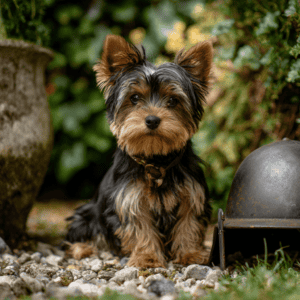
Some heroes charge into battle.
Others fit neatly inside a soldier’s helmet.
The story of Smoky, a Yorkshire Terrier who served in World War II, is one of the most extraordinary reminders that bravery is not measured in size, volume, or muscle. Sometimes, it comes wrapped in silky fur and weighs barely two kilograms.
Smoky’s story begins in 1944 in the jungles of New Guinea. An American soldier found a tiny, scruffy Yorkie abandoned in a foxhole. No owner. No supplies. No explanation for how such a small dog ended up in a war zone. The soldier sold her for a small sum to Corporal William A. Wynne, who had no idea he’d just met a legend.
Smoky was barely a year old, small enough to be carried everywhere, and tough enough to survive conditions that tested grown men. From the moment she joined Wynne, Smoky became his constant companion. She slept in tents, survived air raids, and travelled thousands of miles across the Pacific, all while remaining fiercely loyal and utterly unfazed by danger.
What makes Smoky’s story remarkable isn’t just that she survived the war. It’s that she actively helped win it.
During one mission, Allied forces needed to run a vital communication line through a long, narrow pipe under an airstrip. The pipe was too small and dangerous for a human soldier to enter. Any delay would have left the aircraft grounded and vulnerable.
Smoky was sent in instead.
With a line tied to her harness, she crawled through the pipe, navigating darkness, noise, and confined space without panic. On the other side, she emerged calmly, allowing engineers to pull the cable through in minutes instead of days. That single act saved time, lives, and resources, and cemented Smoky’s place in military history.
But Smoky wasn’t only a working dog. She was morale.
In hospitals, Smoky visited wounded soldiers, performing tricks, curling up beside beds, and offering comfort in a way no speech ever could. Many historians credit her as one of the earliest recorded therapy dogs, long before the term existed. In the middle of trauma and loss, Smoky reminded soldiers of home, normality, and gentleness.
Yorkshire Terriers are often dismissed as decorative or delicate. Smoky shattered that stereotype completely.
Yorkies were originally bred as working dogs, ratters in mills and mines, fearless despite their size. Smoky embodied that history perfectly. She wasn’t loud. She wasn’t aggressive. She was alert, intelligent, and steady under pressure. She trusted her human, and that trust carried her through explosions, aircraft engines, and war zones.
After the war, Smoky returned home with Wynne and became something of a celebrity. She appeared in newspapers, marched in parades, and continued visiting hospitals. Wynne even taught her to jump through hoops and walk tightropes, skills she performed well into old age.
Smoky lived to be around 14 years old, an impressive lifespan for her time, and when she passed, her legacy didn’t fade. Today, memorials to Smoky stand across the United States, honouring not just her service, but what she represents.
She represents the overlooked.
The underestimated.
The small who refuse to be insignificant.
In a war defined by machinery, numbers, and destruction, Smoky’s contribution feels deeply human. Or perhaps deeply canine. She didn’t question orders or fear outcomes. She responded to trust, love, and responsibility, and she rose to meet them.
Smoky’s story matters because it reminds us that courage is quieter more often than it is loud. That strength can look like softness. And that sometimes, the bravest soul in the room is the one everyone else underestimated.
Pickles’ Aside: I may be small, but I bark like I mean it.
Here’s where Smoky the War Dog is remembered with monuments and memorials around the world — a remarkable legacy for a Yorkshire Terrier who changed lives during and after World War II:
United States
• Smoky’s Final Resting Place — Cleveland Metroparks, Rocky River Reservation, Lakewood, Ohio
A bronze statue of Smoky sitting in a WWII GI helmet marks her grave in the Rocky River Reservation near Cleveland. The memorial, dedicated on Veterans Day in 2005, honours her service and commemorates all canine war heroes.
• National Museum of the U.S. Air Force — Dayton, Ohio
Smoky is honoured with displays recognising her contributions as a war dog and early therapy dog.
• Ohio Veterinary Medicine Association Animal Hall of Fame — Columbus, Ohio
Smoky is listed in the Hall of Fame as one of the most heroic dogs in history.
• City of Eastlake, Ohio — “Smoky and Dogs of All Wars”
Another tribute location in Ohio recognising her and other service dogs.
• American Kennel Club Museum of the Dog — St. Louis, Missouri
Smoky has been honoured here as part of canine history exhibits.
• University of Tennessee College of Veterinary Medicine — Knoxville, Tennessee
Home to a memorial titled “Four Pounds of Courage” celebrating her story.
• Hickam Air Force Base — Hawaii
The 26th Airspace Intelligence Squadron (successor to Smoky’s unit) honours her service with a display.
Australia
• Royal Brisbane & Women’s Hospital — Brisbane, Queensland
Smoky is memorialised here with a tribute acknowledging her impact during WWII and her ongoing inspiration to military service and therapy work.
These memorials celebrate Smoky not just as a war dog, but as a pioneer in morale-boosting and therapeutic service, showing how one tiny dog left a huge legacy.