
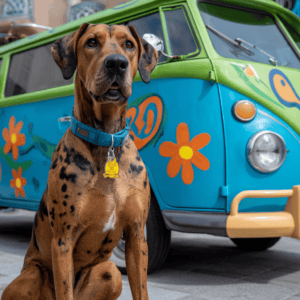
Before we knew what anxiety was, before we understood friendship dynamics, and long before we learned that most problems are just men in masks, there was Scooby-Doo.
Scooby wasn’t sleek. He wasn’t heroic in the traditional sense. He didn’t charge into danger with confidence or clever plans. Scooby ran. Scooby hid. Scooby screamed. And somehow, despite all of that, he always saved the day.
First appearing in 1969 in Scooby-Doo, Where Are You!, created by the legendary Hanna-Barbera, Scooby-Doo became a staple of Saturday morning television. For generations of children, he was part of a weekly ritual. Cereal bowls, pyjamas, slightly too loud TV volume, and the comforting knowledge that whatever monster appeared would absolutely turn out to be fake.
Scooby’s world was spooky, but safe. The castles crumbled, the ghosts rattled chains, and the villains laughed maniacally, but no one ever truly got hurt. And at the centre of it all was a very large dog who would have preferred to be literally anywhere else.
What made Scooby special was never bravery. It was honesty.
Scooby was scared, and he admitted it. He clung to his best friend Shaggy Rogers, shared his snacks, and screamed in perfect harmony. Together, they represented the part of us that wanted comfort, reassurance, and a really good sandwich before facing literally anything.
And yet, when it mattered, Scooby always showed up.
Disguised, trembling, usually bribed with food, but there nonetheless.
Scooby is famously a Great Dane, which is deeply funny when you consider how the breed is often described in real life. Great Danes are known as gentle giants. Calm, affectionate, and often convinced they are lap dogs despite being roughly the size of a small horse.
Scooby, however, took the Great Dane stereotype and spun it into cartoon gold. He was tall and gangly, expressive to the point of absurdity, and capable of turning fear into slapstick ballet. Running in mid-air, sliding around corners, hiding inside impossibly small objects, Scooby made fear funny.
That matters more than we probably realised at the time.
Scooby-Doo taught children that being afraid didn’t make you weak. It made you honest. Courage wasn’t about being fearless. It was about doing the thing anyway, preferably with backup and snacks.
There was also something deeply comforting about the formula. Every episode followed the same rhythm. Mystery. Monster. Panic. Chase music. Unmasking. Explanation. Relief. The world made sense again. The bad guy was caught. And Scooby got a Scooby Snack.
In a chaotic world, Scooby-Doo was structure.
The friendship between Scooby and Shaggy was the emotional heart of the show. They didn’t judge each other. They didn’t push each other to be braver than they were ready for. They protected each other, fed each other, and ran away together. That kind of loyalty is rare, and it resonated deeply.
For many kids, Scooby was also their first introduction to dogs as emotional beings. He wasn’t a prop or a sidekick. He was a character with preferences, fears, and needs. He loved food, comfort, and familiarity. He hated danger and confrontation. He was relatable in a way that made dogs feel like family, not accessories.
Watching Scooby-Doo now feels like stepping into a softer version of fear. The spooky settings still work, but they’re wrapped in humour and predictability. Even the villains, once unmasked, seem more pathetic than threatening. Scooby helped us learn that fear often looks scarier from a distance.
Real Great Danes, much like Scooby, are often sensitive souls. Owners frequently describe them as gentle, affectionate, and surprisingly clingy. They bond deeply with their people and prefer comfort over chaos. Scooby may have exaggerated the fear for comedic effect, but the emotional sensitivity rings true.
Scooby-Doo also endures because he never changed his core. Through reboots, films, and updates, Scooby remained Scooby. Still hungry. Still scared. Still loyal. Still good-hearted.
In a world that constantly asks us to be braver, louder, and more confident, Scooby-Doo quietly reminds us that it’s okay to be scared, as long as you keep going.
Preferably with snacks.
Pickles’ Aside: I also face my fears with food. It’s called strategy.